Days You Cannot Buy Back: How Outdated Routing Strategies Are Destroying Shelf Life for US Specialty Food Importers
There is a cost in the specialty food import business that never appears on a freight invoice. It does not show up in the customs declaration or the carrier's rate card. It accumulates silently, measured not in dollars but in days—and by the time it becomes visible, it has already done its damage. That cost is transit time, and for importers moving Chilean berries, cold-water seafood, artisanal cheeses, and heritage produce into US markets, it is increasingly the difference between a profitable shipment and a written-off one.
The problem is structural. Many US importers sourcing perishables from South America still rely on routing architectures that were designed for durability goods—freight models built around East Coast consolidation hubs like Miami or Atlanta, where shipments are received, re-sorted, and redistributed before reaching their final destination. For a container of copper fittings or a pallet of textiles, a 36- to 48-hour hub delay is an inconvenience. For a shipment of fresh blueberries or live king crab, it is a market window closing in real time.
What the Calendar Actually Looks Like
Consider a representative scenario: Chilean blueberries harvested in the Bio-Bío region and destined for a specialty grocer in Chicago. Under a traditional routing model—air freight from Santiago, connection through Miami, domestic forwarding to Chicago—total transit time from farm gate to retail floor typically runs between five and seven days, assuming no delays at the Miami hub. Fresh blueberries, depending on post-harvest handling, carry a commercially viable shelf life of approximately 10 to 14 days under proper refrigeration.
On a seven-day transit, the retailer receives product with, at best, seven days of remaining shelf life. After accounting for the retailer's own receiving and stocking cycle—typically one to two days—the product reaches the consumer with five to six days before quality degradation begins. For a specialty grocer charging a premium price point, that window is uncomfortably thin.
Now compare that to a point-to-point routing model originating at Arturo Merino Benítez International Airport in Santiago, connecting directly to O'Hare or Midway via a single-connection itinerary. Total transit time in this configuration routinely falls between three and four days. The same blueberries arrive in Chicago with nine to ten days of remaining shelf life—a difference of roughly four days that translates directly into reduced shrink, stronger sell-through rates, and a meaningfully better margin picture for the importer.
The Real Cost Comparison
Freight managers accustomed to evaluating routes purely on rate-per-kilogram often undervalue this differential. The math, however, is unambiguous when total landed cost is properly calculated.
Assume a 500-kilogram blueberry shipment with a declared value of $8,000. Under the hub-routing model, the air freight rate from Santiago through Miami to Chicago might be quoted at $3.20 per kilogram, yielding a freight cost of approximately $1,600. That figure looks competitive on paper. But apply a conservative 15 percent shrink rate attributable to the extended transit—a figure well within industry norms for soft fruits arriving with compressed shelf life—and the importer absorbs roughly $1,200 in unsellable product before a single item reaches a consumer.
Effective freight cost under this model: $2,800, or $5.60 per kilogram.
Under a direct Santiago-to-Chicago routing, the rate per kilogram may carry a modest premium—call it $3.75 per kilogram, or $1,875 total. But with shrink rates dropping to the 4 to 6 percent range on fresher-arriving product, actual loss exposure falls to approximately $320 to $480. Total effective cost: $2,195 to $2,355, or roughly $4.40 to $4.71 per kilogram.
The apparent savings of the hub model evaporate entirely once spoilage is factored in. The importer who chose the cheaper rate paid more.
Santiago's Structural Advantage
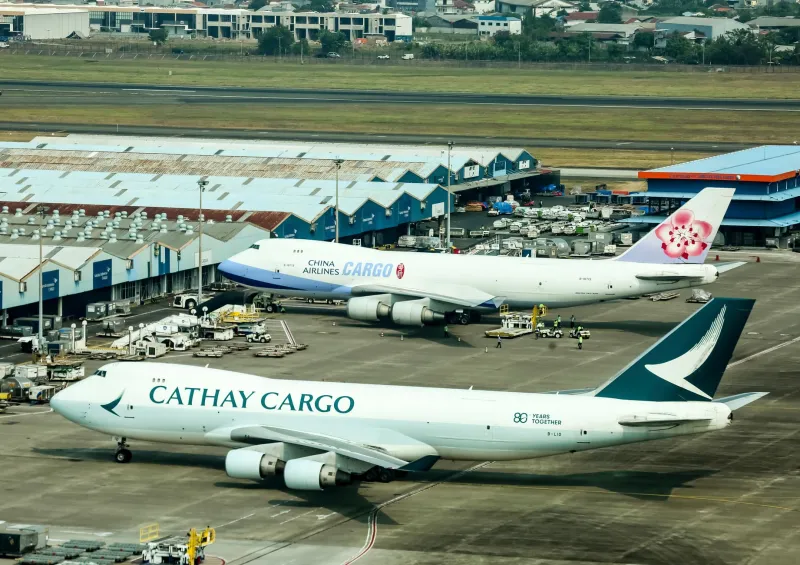
This calculus is not accidental. Santiago's position as South America's most operationally mature air-freight hub is the product of deliberate infrastructure investment. Arturo Merino Benítez consistently ranks among the continent's top airports for cargo throughput, cold-chain handling capacity, and on-time departure performance. The airport maintains dedicated perishables facilities with continuous temperature monitoring, and several major international carriers operate scheduled freighter services—not just belly cargo—between Santiago and key US gateway cities.
The practical implication for specialty food importers is that the infrastructure required to move temperature-sensitive cargo quickly and reliably already exists. The question is whether importers are designing their routing strategies to take advantage of it, or defaulting to legacy models that were never built with perishables in mind.
For seafood importers, the stakes are even higher. Chilean sea bass, Patagonian king crab, and salmon—all sourced in volume from Chilean waters—carry premium price tags that are entirely dependent on freshness. A seafood buyer in Boston or Seattle will pay $28 per pound for a product that arrives with eight days of shelf life. That same buyer will negotiate aggressively, or refuse the shipment entirely, if the product arrives with three. The routing decision made in Santiago has a direct downstream effect on the price the importer can command at point of sale.
Artisanal Products and the Fragility Premium
Beyond produce and seafood, artisanal and small-batch food products present their own routing challenges. Chilean artisanal cheeses, cold-pressed olive oils from the Maule Valley, and small-production charcuterie are increasingly sought by US specialty retailers and restaurant groups. These products often lack the industrial preservation treatments that extend shelf life in mass-market equivalents. They are, by design, closer to their source—and therefore more vulnerable to the compounding effects of transit time and temperature fluctuation.
For these categories, hub-routing is particularly punishing. Every additional handling event—a transfer at Miami, a sort at a domestic hub, a delay in customs re-examination—introduces both time and thermal risk. Products that left Santiago in optimal condition can arrive at a US retailer in a condition that reflects poorly on the importer and, by extension, on the Chilean producer.
Direct routing mitigates this exposure by reducing the number of handling events and compressing the overall transit window. Importers who have made this shift report measurably lower rejection rates and stronger reorder frequency from retail buyers—outcomes that are difficult to quantify on a freight invoice but unmistakable in the commercial relationship.
Rethinking the Route as a Business Decision
The specialty food import market in the United States is growing, and competition for shelf space and buyer attention is intensifying. In that environment, product quality at the point of delivery is not a logistical detail—it is a competitive differentiator. Importers who consistently deliver fresher product, with more remaining shelf life and lower shrink rates, earn preferred-vendor status with retailers and command better pricing from buyers.
Routing strategy is a direct input to that outcome. The choice of whether to move a perishable shipment through a multi-hub architecture or a streamlined direct corridor from Santiago is not merely an operational preference. It is a business decision with measurable consequences for revenue, margin, and commercial relationships.
For US specialty food importers who have not recently audited their routing assumptions, the exercise is overdue. The days lost in transit cannot be recovered. But the decision to stop losing them can be made today.